
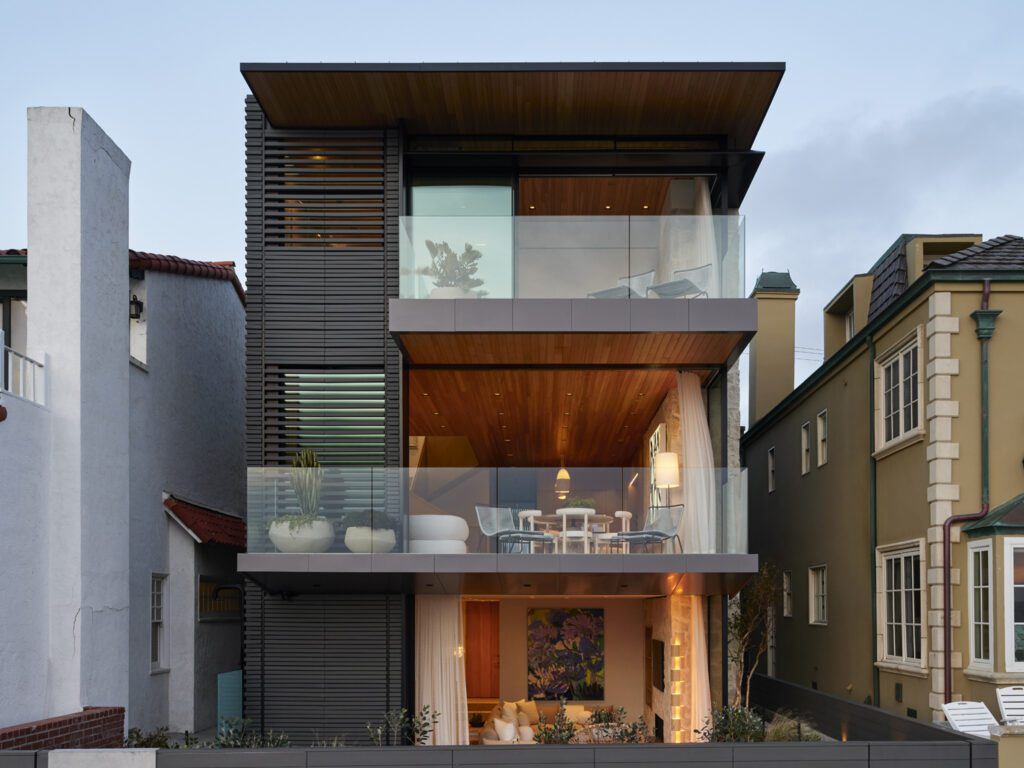
The contrasts abound on a site just south of Manhattan Beach in Southern California. It’s a mere sliver of land, thirty feet wide by eighty feet deep, its backside snugged up to an alley. But out front and to the west are endless views of Pacific sunsets laced in orange, pink and raspberry. A little closer is the Strand, a public walkway packed with bikes, dogs, gawkers, skateboarders and muscle-bound volleyballers. But this site is dedicated to privacy too— inside a three-story home that serves as a gallery for an artist who collects and displays works by others from coast to coast.
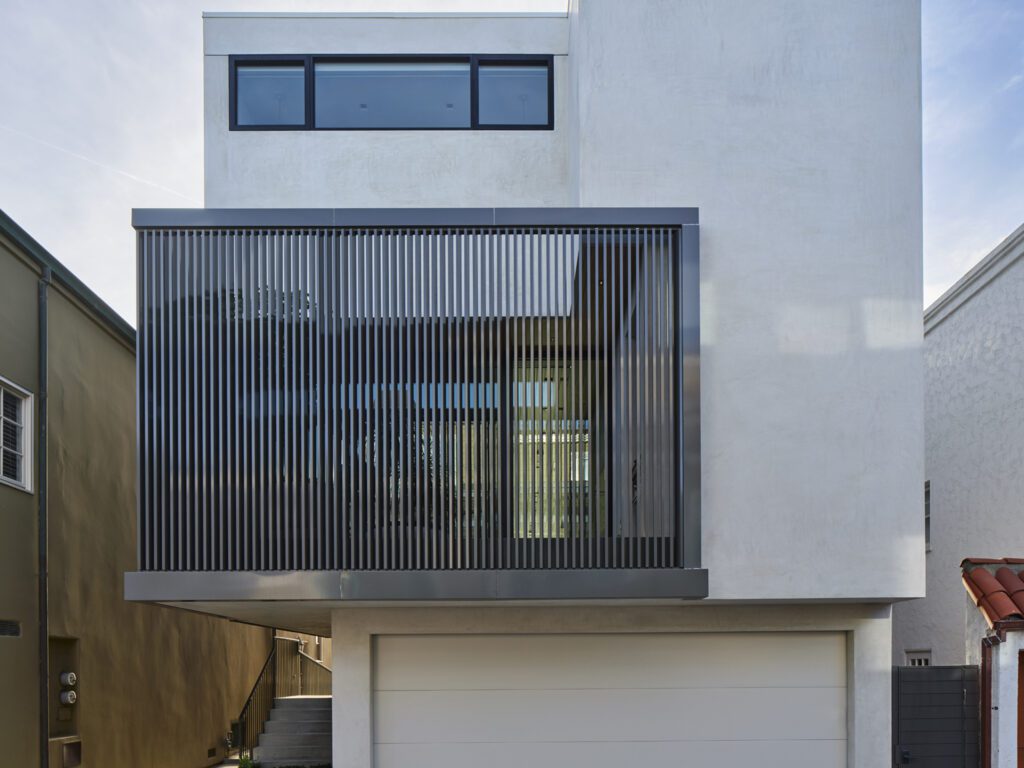
She’s Boston–based, and began visiting her daughter in Manhattan Beach a few years back. She was renting homes there until she discovered this lot on laid-back Hermosa Beach, a 1.43-acre town known for its closeknit urban fabric and artist community. To design her new home, she brought in local architect Anthony Laney from the firm that bears his name. He set out to design a home that captures the feel of a small, densely populated beach town—but places a premium on privacy.
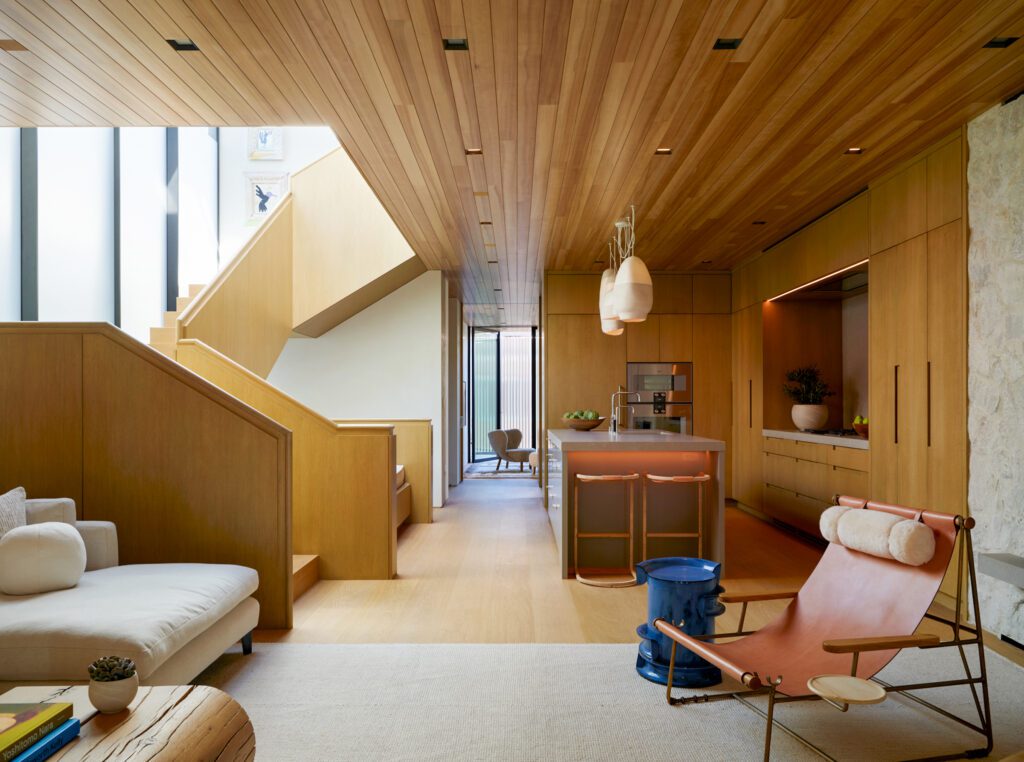
He dropped this home into a very public space—with an architecture that worships the ethos of rest and tranquility. “How do you get it to open up to the view, but also get privacy and intimacy?” asks Laney, a dedicated fan of California modernism from greats like Richard Neutra, Rudolph Schindler and John Lautner.
He answered that question by segregating the functions of each level in the 3,987-squarefoot residence. “We put the bedrooms at the very top, with a balcony up there for natural privacy,” he says. “The living room is on the middle level for an unobstructed view of the horizon line of the ocean.”
The ground level is essentially an entertainment area, with an outdoor patio, a built-in couch on three sides and a fire pit on the fourth. It’s all sunken two-and-a-half feet down, which adds ceiling height and hides anyone seated there from onlookers passing by on the Strand. “If you’re standing up, you can make direct eye contact with people going by,” he says. “That’s when you engage with the energy on that public boardwalk.”
For interior design throughout the house, Laney collaborated not just with the client, but with Matthew Woodward of Boston-based Hacin. This is the fourth project Woodward’s worked on with this client—and here he was careful to defer to and collaborate with the architect’s intent. “There was an ease, a flow and a shared vision,” he says. “The interiors are woven into the architecture, not sitting on top of it,” he says. “
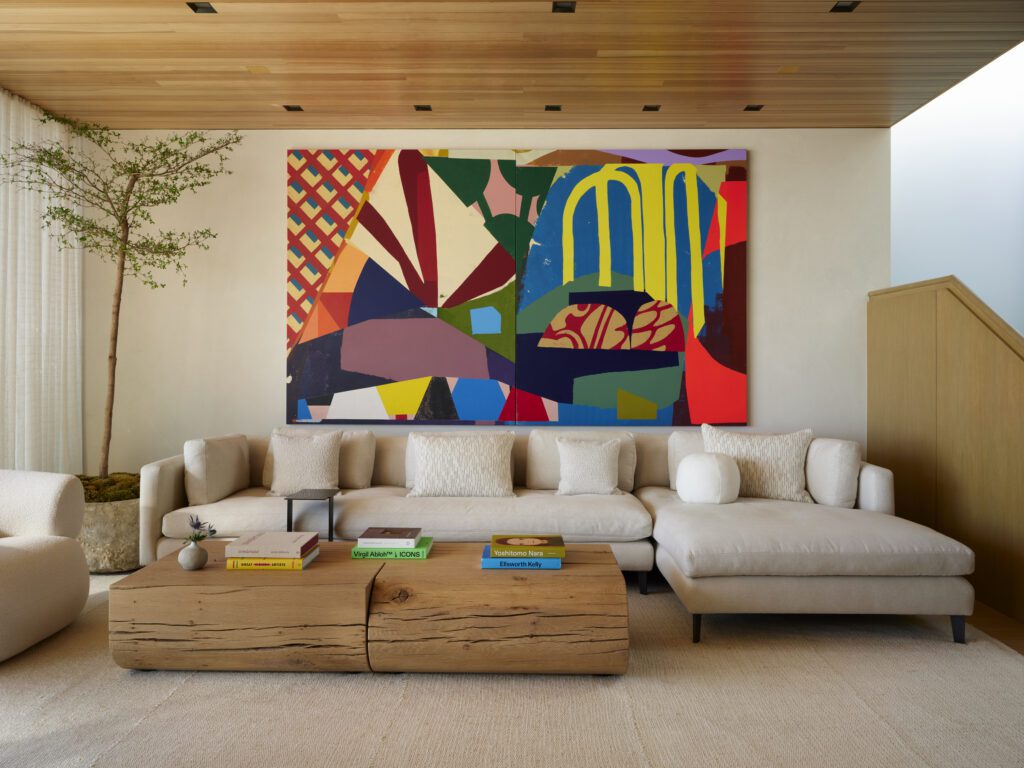
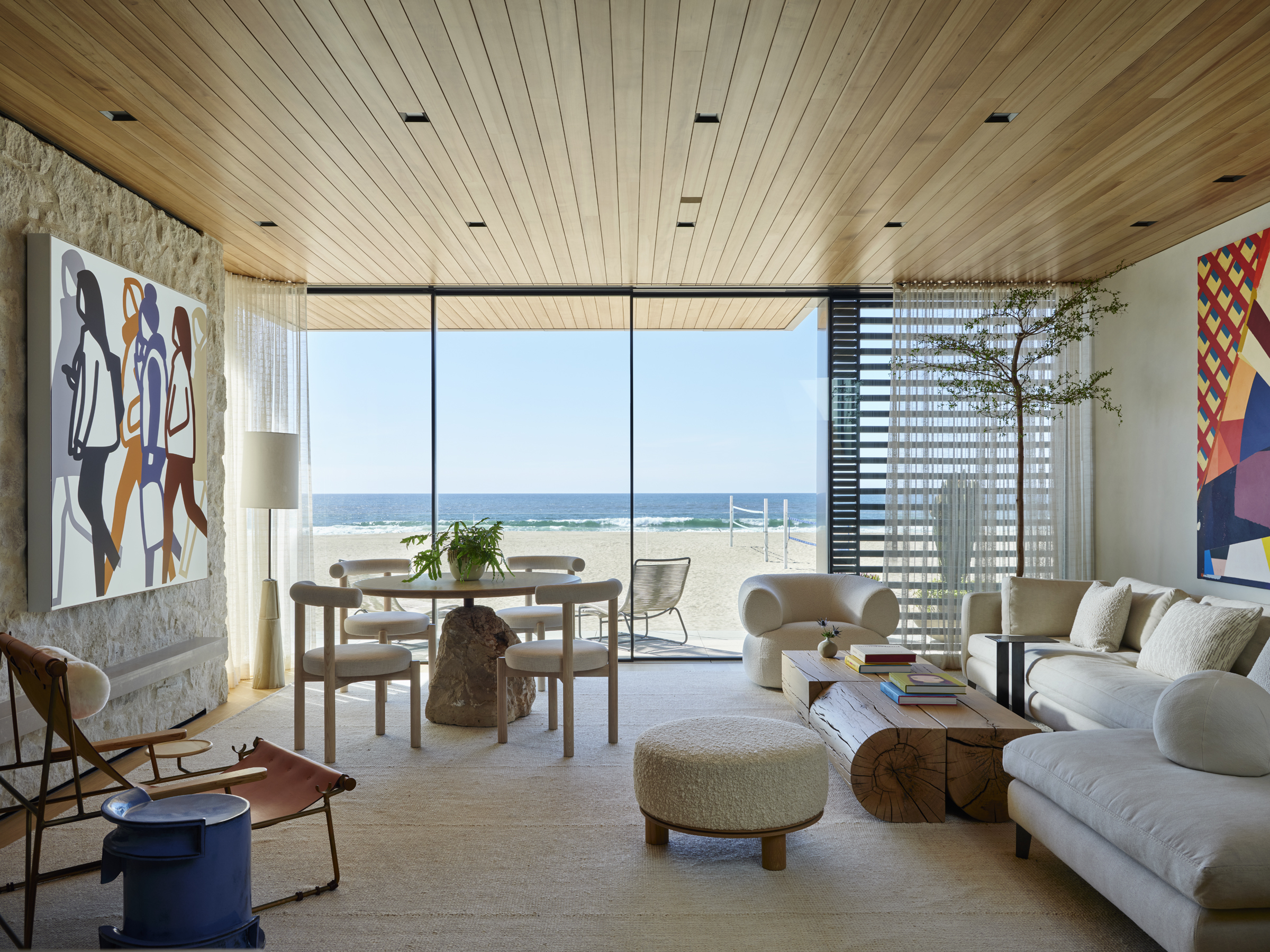
The client favored a monochromatic canvas for the home, using her contemporary art collection for pops of color. She’d been saving these particular works for some time before buying the lot and designing the home. The material palette defers to the artwork. “Most clients can talk about structure and form and then get to materials later, but she was materials first,” Laney says. “She loves art and has a real passion for it.”
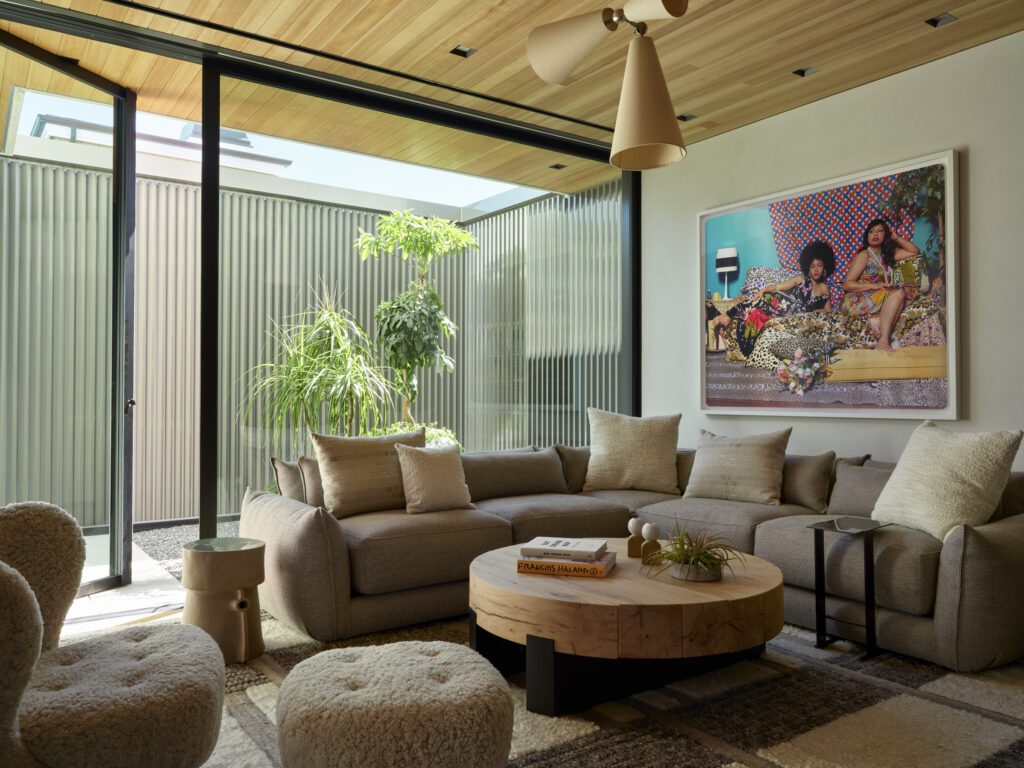
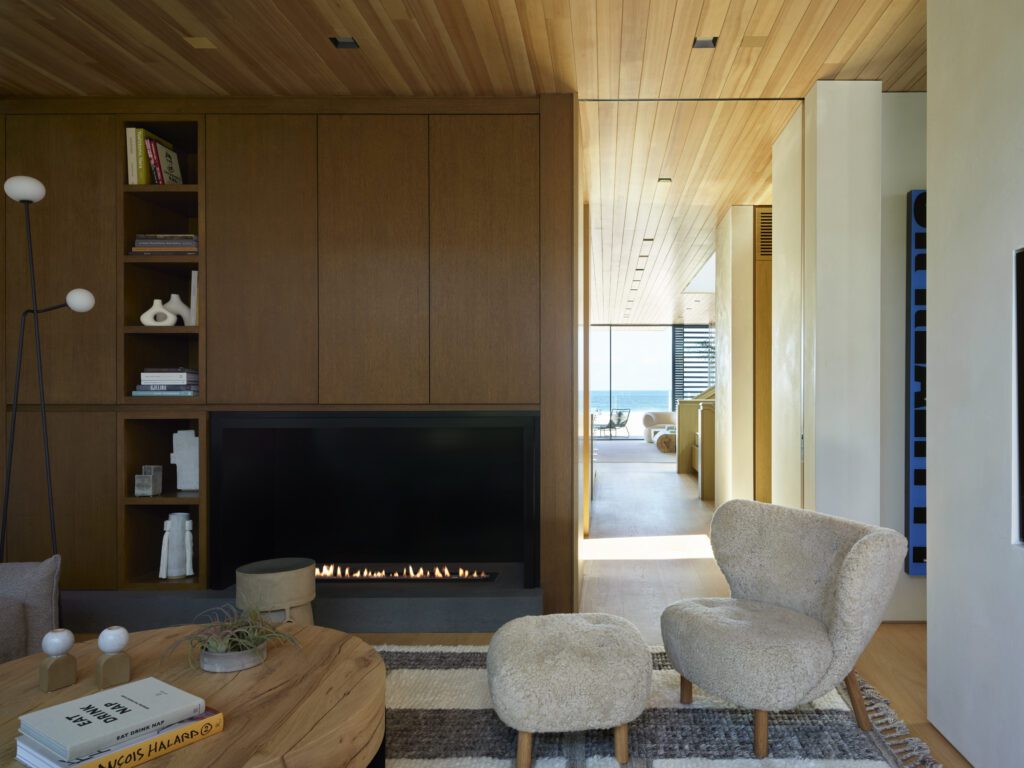
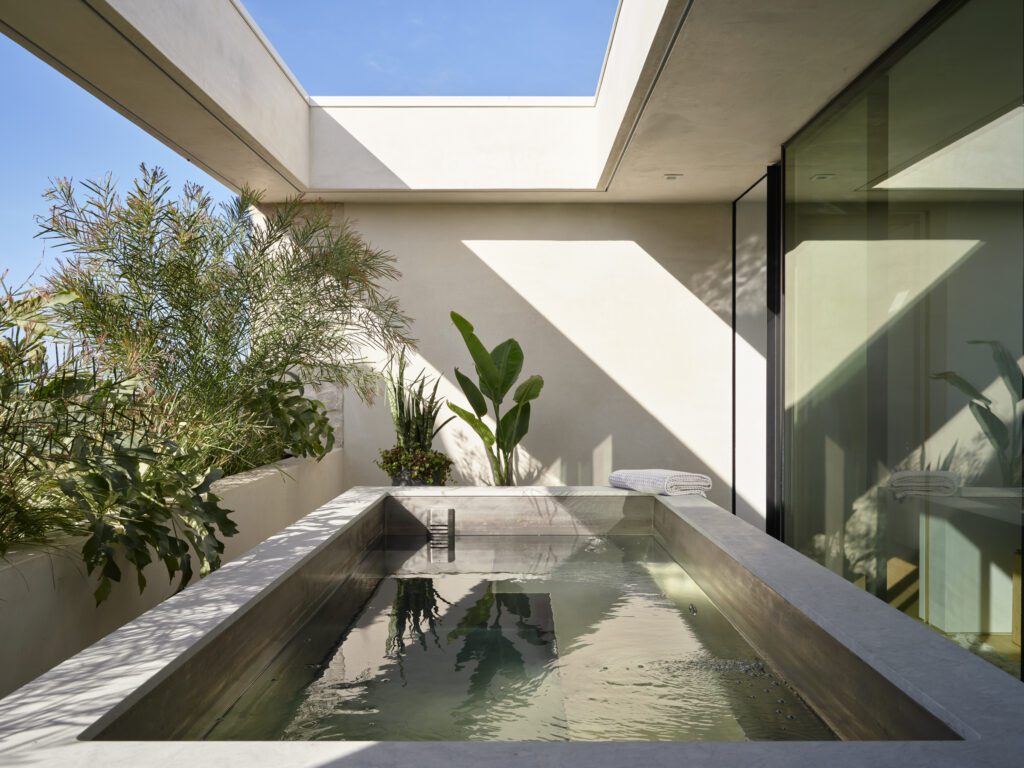
A Spanish rubble limestone volume, visible from each level, anchors the architectural massing. The ceiling is tongueand-groove hemlock from British Columbia. The flooring and stairwell are white oak, while plastered walls offer a swirling depth. Doors and windows are an aluminum Optima system from Portugal. Through them the living, natural elements of Hermosa Beach linger generously in the distance—including sand, ocean, and sky. “It would have been foolish not to work with the outside,” Woodward says.
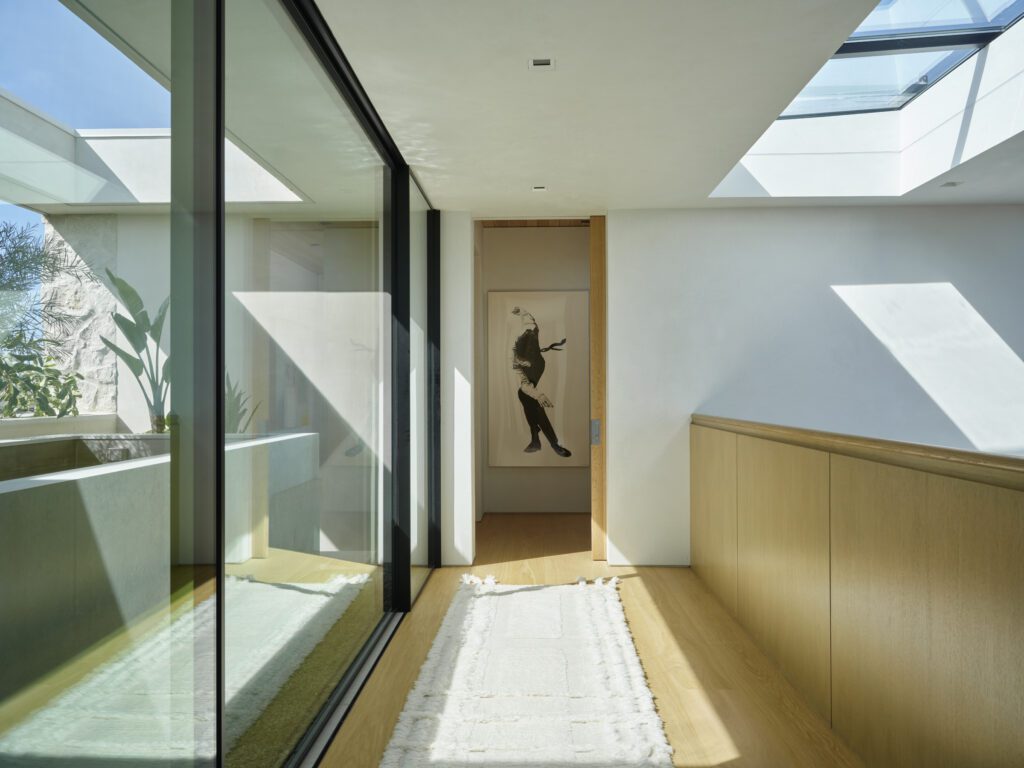
Inside, works by artists like Robert Longo and Julian Opie, among others, play key roles in the gallery-like spaces. “She started with the art, and then we’d build interiors around it,” Woodward says. “We knew we had to pull back in a way in some areas, for ways to showcase the art the most.” He used sculptural light fixtures and other handmade pieces that aren’t too obtrusive, but complement the home’s modern design.
Laney’s favorite piece is the LED-lit Julian Opie, depicting a group of walking friends, one that’s easily viewed by those walking along on the Strand. “It’s wonderfully visible,” he says. “That piece, more than any other, is integral to the house.” It’s also contextual, raising the age-old question of whether art imitates life, or viceversa.
FOR MORE INFORMATION, VISIT