
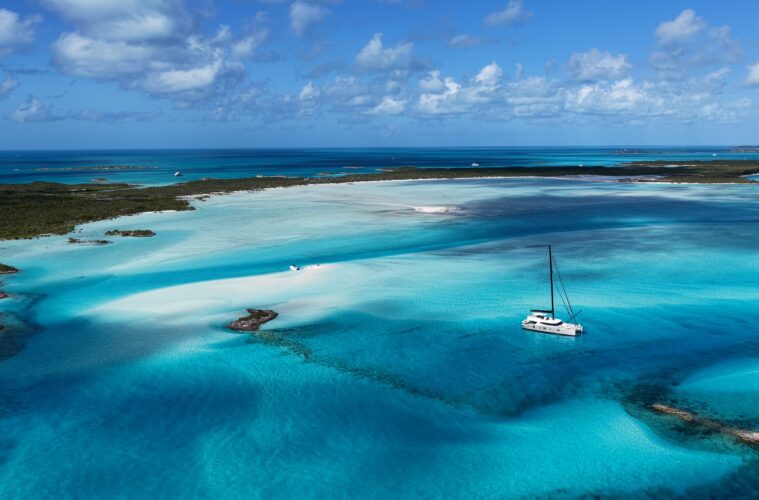
Picture the thing the brochure promised. A low green cay ringed in sand so pale it reads as white until the light shifts and turns it faintly pink. Water in three separate blues before it reaches the horizon. No skyline, no traffic, no one—just a stretch of the Exumas, that scatter of 365 islands where the yachts have always gone precisely because there was nothing there to find.
That image is the one Fyre Festival sold in 2017, and the reason the fraud worked at all is that the fantasy was genuinely intoxicating. What the con couldn’t do was build it. Villas that didn’t exist, on islands with no way to make them real—the collapse was so complete it produced two documentaries and a permanent punchline.
Here is the twist worth paying attention to: the fantasy was never the lie. The emptiness, the water, the barefoot seclusion—all of it was real, and always had been. The only thing missing was someone who could actually build for it. Before the end of the decade, three of the most exacting names in the world will have done exactly that. Aman, Rosewood, and Bulgari are each opening in the Exumas within a few years of one another—and the most fascinating part is that no two of them agree on what luxury, on this water, should feel like.
Aman: the Luxury of Less
Begin with Aman, because Aman is the one your architect already reveres.
Over three decades, the brand built something close to a philosophy: that the highest luxury is subtraction. Fewer keys. Less noise. Nothing between you and the landscape but a threshold you can barely perceive. That restraint rewired residential design far beyond hospitality; the whole vocabulary of “quiet luxury” your favorite designers now speak traces back, in large part, to what Aman taught them to remove.
Its Bahamian debut is named, perfectly, Amancaya—”peaceful island” in Taíno, the language of the people who knew these cays first. It will spread across roughly 400 acres on two entirely private cays, and the telling number is how little will sit on all that land: a resort of just 36 pavilions and a small collection of three-to-five-bedroom residences, each with its own pool and the kind of indoor-outdoor plan that treats a wall as optional. Of the three brands arriving in the Exumas, Aman took the most room and will build the least on it—which is the whole argument in a sentence.
The design roster is the tell for anyone who reads these things closely: architecture by Jacobsen Studio, interiors by Yabu Pushelberg, landscape by Raymond Jungles. That is a lineup assembled to make buildings disappear into a shoreline rather than announce themselves against it. On a cay with no skyline to screen out and no neighbor to wall off, Aman’s instinct—to know what not to interrupt—has almost nothing to push against and everything to frame. The luxury here is the emptiness itself, in the hands of the one house that treats emptiness as a material.
Bulgari: the Luxury of More
Then, a short stretch of water away, the opposite conviction.
Bulgari’s arrival is the Bulgari Resort & Residences at Cave Cay, opening in 2029 on a 220-acre private island of white beaches, hidden caves, and hills that fall to clear water. The plan runs to 64 suites and seafront villas—and 48 privately owned Bulgari Mansions and estates. Mansions. Where Aman removes, Bulgari declares. The house began as a jeweler on Rome’s Via dei Condotti, and it shows: this is a jeweler’s idea of paradise, not the absence of everything but the presence of the finest of everything, glamour worn openly, the island as a setting for a jewel rather than the jewel itself. Same impossible water, entirely different answer to the question of what belongs beside it.
Neither is more correct. They are two genuine visions of the good life, and part of the pleasure here is that you already know which one is yours.
Rosewood: the Luxury of Both
And then Rosewood, which declines to choose—and may be the most beguiling for it.
Rosewood Exuma opens in 2028 on East Sampson Cay, 124 acres of which only a quarter will ever be built, the rest left as it was found. The resort holds just 33 suites, several set directly on the pink-and-white sand — scarcity worthy of Aman. But inside that intimacy, abundance: a 20,000-square-foot Asaya wellness sanctuary with hydrotherapy and treatment rooms open to the trade winds; six places to eat, some drawn from an organic garden on the island itself; two marinas ready for yachts up to 150 feet; courts for tennis and padel; a children’s club built around the culture of the Exumas. It is seclusion and abundance at once, wellness and adventure in the same breath — held together by the brand’s guiding idea, “A Sense of Place,” which insists that a resort should taste of the exact patch of earth it stands on.
Three names. One archipelago. The luxury of less, the luxury of more, and the luxury of refusing the choice—each wagering that its vision is the one this water was waiting for. For the reader who has ever stood on a beautiful shore and wondered what it would take to stay, the coming years in the Exumas are going to be a remarkable thing to watch, because the answer is being built three different ways at once.
Why the World’s Great Houses Arrived at the Same Address
That all three came now, and here, is not chance. It is the clearest sign yet of where the luxury coast is heading.
The branded residence—a home carrying a hotel or fashion name, its design and service woven in—has become the most coveted product in luxury real estate. The count of such projects worldwide has nearly tripled since 2015, and buyers reliably pay around a 31 percent premium for a residence with a great name on the door, according to Savills. What they are buying is not a logo. It is the assurance that the sensibility they love in a hotel or a house will shape the place they wake up every morning, and that a culture of service stands behind it.
The Bahamas sharpens the appeal further—no income, capital gains, or inheritance tax, and a flight from the eastern seaboard counted in hours rather than half-days. And the Exumas are only the headline: a Ritz-Carlton Reserve is coming to Eleuthera, a Banyan Tree to Bimini, a Six Senses to Grand Bahama. But it is the three great houses on these particular cays, each so sure of a different answer, that signal how much ambition this coast can now hold.
The Mastery You’re Meant Never to See
There is an art to all of this that the finished photographs will never show, and it is worth knowing, because it is the reason the ease feels effortless.
Building on a low cay is among the hardest things in architecture. There is no power grid, no municipal water, no lumberyard at the end of the road. Every slab of stone, every window, every fixture arrives by barge across open water. Beneath the serenity, these resorts run on desalination plants, private microgrids, and engineering quiet enough that a guest at the spa never suspects it exists. The genius is precisely that you are meant to feel none of it — to sense only sea air and stillness while, out of sight, a small miracle of coordination keeps the whole dream aloft.
The same discipline shows in how the best of these developers treat the islands themselves. Aman leaving hundreds of its acres barely touched, Rosewood building on only a quarter of its cay and powering the property partly by sun, both designing their buildings to vanish into the tree line—that restraint is not a constraint on the luxury. On a coast this fragile, it is the luxury: the confidence to build lightly, so that what drew everyone here in the first place is still here in a generation.
The Fantasy, Made Real
The wonder of it is the reversal. Nine years ago, these islands were shorthand for a paradise that was promised and never delivered—beautiful renderings with nothing behind them. Now three of the most demanding names in the world are betting fortunes that the paradise was always real, and that the only thing ever missing was the mastery to build it and the restraint to build it well.
The tents came down long ago. What’s rising in their place is the thing the fantasy always pointed to—and this time, someone knows how to make it stay.